
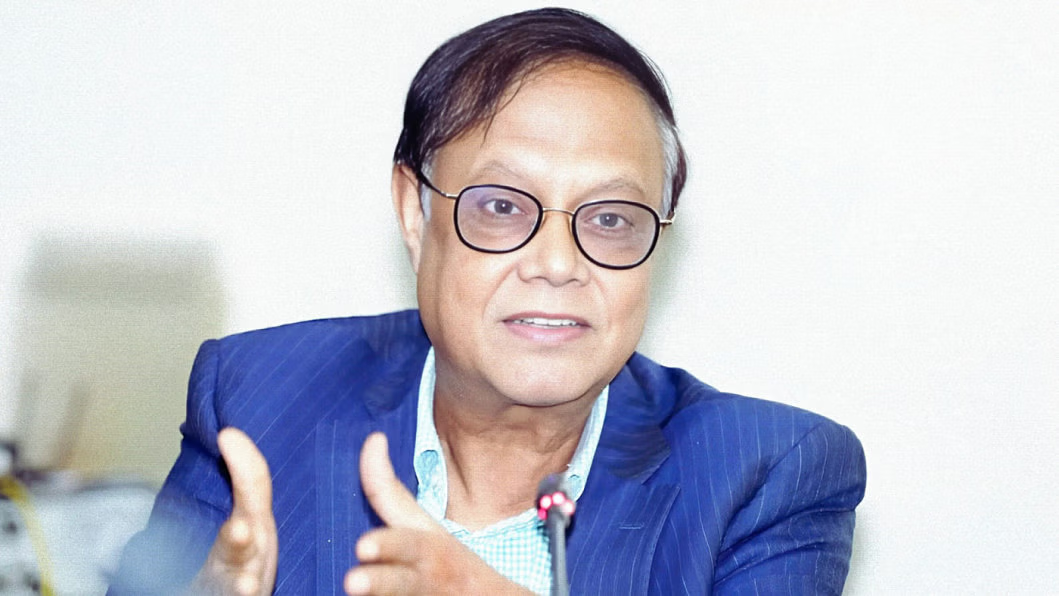
In a major move to reform the banking sector, Bangladesh Bank is set to kick off the merger process of five Shariah-based banks as early as next month, Governor Ahsan H Mansur announced at a press briefing on Sunday.
The central bank plans to consolidate First Security Islami Bank, Global Islami Bank, Union Bank, Social Islami Bank, and EXIM Bank into a single entity, with officials confirming that preparations are already underway.
Governor Mansur assured that no employees would lose their jobs due to the merger. However, he mentioned that for better operational efficiency, some urban branches may be relocated to rural areas.
Dismissing any political motives, Mansur clarified that the merger is purely a structural reform and has no connection to the upcoming national elections. “This is an ongoing process. We hope the next government will carry it forward,” he stated. He also hinted that state ownership could be considered for managing some of the struggling banks involved.
Alongside this merger, the central bank is stepping up efforts to recover assets that were illegally transferred abroad, often by individuals with political ties—particularly during the tenure of ousted Prime Minister Sheikh Hasina.
Governor Mansur shared that Bangladesh is actively engaged in high-level discussions with the United Kingdom, and has already submitted detailed dossiers on individuals accused of money laundering.
As a result, the UK’s National Crime Agency has frozen £170 million worth of assets linked to former land minister Saifuzzaman Chowdhury Javed. This follows a previous freeze of £90 million related to Shayan Rahman and Shariar Rahman of Beximco Group.
The governor noted that the central bank has also sought mutual legal assistance from several countries and will continue updating foreign authorities with relevant information. However, he made it clear that recovery of any funds depends on final court verdicts.
Bangladesh Bank is preparing to engage in legal proceedings, both domestically and internationally, and is also exploring Alternative Dispute Resolution (ADR) as a faster means to recover funds. In such cases, legal representatives from both parties would work toward settlements outside of court.
“The choice between litigation or ADR will ultimately be made by the government,” Mansur said.
To support these complex legal efforts abroad, international litigation firms have expressed interest in funding the asset recovery process. The central bank is considering the formation of a dedicated fund to back these operations, with hopes that a significant portion of the laundered money can be brought home.



https://shorturl.fm/5mc6M
https://shorturl.fm/TEAqU
https://shorturl.fm/Px1z6
https://shorturl.fm/QxyfY
https://shorturl.fm/ADUT8
https://shorturl.fm/hvbcf
https://shorturl.fm/snxSL
https://shorturl.fm/7C3hF